
Whether participating in Counseling, Coaching, working with a Mentor, or working with a patient Advocate – studies have found that people heal better if they have good emotional and mental health.
Even conventional (also called Western or standard) medicine recognizes the power of the connection between mind and body. Some people also believe the senses, touch, sight, hearing, smell, and taste, can affect overall health.

Biofeedback
The three most commonly used forms of biofeedback therapy are:
- Electromyography (EMG), which measures muscle tension
- Thermal biofeedback, which measures skin temperature
- Neurofeedback or electroencephalography (EEG), which measures brain wave activity
Biofeedback (biofeedback therapy) is an alternative medicine approach that teaches you to change the way your body functions. It’s a mind-body therapy that may improve your physical and mental health. Biofeedback helps you make slight changes in your body, such as relaxing muscles, to help relieve pain or reduce tension. It is a technique that trains people to improve their health by controlling certain bodily processes that normally happen involuntarily, such as heart rate, blood pressure, muscle tension, and skin temperature. Biofeedback is essentially a form of operant conditioning. Operant conditioning is a method of learning that uses rewards and punishment to modify behavior. Biofeedback uses visual or auditory (sound) feedback to encourage desired actions. This helps create behavioral changes. Providers who perform biofeedback should be certified by the Association for Applied Psychophysiology and Biofeedback (AAPB) to use the therapy. Make sure your provider has certification before starting therapy. Many biofeedback experts are licensed in another area of health care, such as psychology, nursing or physical therapy.
Biofeedback is an effective therapy for many conditions, although it is primarily used to treat high blood pressure, tension headache, migraine headache, chronic pain, and urinary incontinence.
During a biofeedback session, a certified healthcare provider places painless sensors or devices on your body. The sensors measure physiological signals from your body and send information to a small monitor that translates the measurements into either a tone that varies in pitch, a visual meter that varies in brightness, or a computer screen that shows lines moving across a grid. The sensors used during a session include the following:
- Breathing with bands around your stomach and chest that have sensors to measure your breathing rate and patterns.
- Heart rate with a pulsometer or sensors pads are placed on your chest, lower trunk or wrists. These pads are connected to an electrocardiogram (ECG) that measures your heart rate and how your heart rate changes. A sensor also can be placed on your finger to measure your heart rate.
- Muscle movement and tension using surface electromyography (sEMG), which involves sensors on your skin above certain muscles. This helps make you aware of muscle tension.
- Sweat gland activity with galvanic skin response (GSR) sensors, usually attached to your fingertips and/or palm, or wrist. The amount of perspiration on your skin warns you of nervousness.
- Brain Activity using an electroencephalogram (EEG), which involves sensors attached to your scalp. EEG biofeedback is also called neurofeedback. There are certain brain waves that show different mental states, such as relaxation, wakefulness and sleep.
- Skin temperature Pads attached to your fingers or feet measure blood flow to your skin. Because your temperature often drops when you’re under stress, a low reading can prompt you to begin relaxation methods. As you become more relaxed, your fingers and toes may become warmer.
- Portable/wearable One type involves wearing a measuring pad on your waist that monitors your breathing patterns using a downloadable app. The app can let you know if you’re tense and give you breathing activities to restore calm.
Computers process the information from these sensors or devices and quickly report it back to you. As you receive the feedback, your provider will explain what it means. Then, they’ll suggest strategies to change how your body is functioning. This will vary depending on your reason for getting biofeedback therapy.
Biofeedback is considered safe. Biofeedback machines might not work on people with some medical problems, such as heartbeat issues or some skin diseases. If you have serious mental health issues, check with your psychiatrist to make sure you are an appropriate candidate for biofeedback. A typical biofeedback treatment lasts 30 to 60 minutes. How many treatments you have and how long they last depend on your health problem and how quickly you learn to control your body’s responses. The goal of biofeedback is to learn to use these methods at home on your own without a machine or sensors.
The Association for Applied Psychology and Biofeedback (www.aapb.org) is a good resource for finding qualified biofeedback practitioners in your area.
Counseling
Cognitive
Cognitive Behavioral Therapy (CBT) – Combining both cognitive and behavioral approaches, CBT focuses on how thoughts and behaviors dictate a person’s feelings in a given situation and then affect outcomes; or in other words, works to identify the thought patterns and behaviors related to presenting problems. . A variety of different techniques and components may be included in CBT, such as exposure, social skills training, cognitive restructuring, problem-solving training, journaling, and relaxation training. CBT places an emphasis on helping individuals learn to be their own therapists. Through exercises in the session as well as “homework” exercises outside of sessions, patients/clients are helped to develop coping skills, whereby they can learn to change their own thinking, problematic emotions, and behavior. CBT therapists emphasize what is going on in the person’s current life, rather than what has led up to their difficulties by using a scientific approach regarding patient patterns, observing outcomes, intervening as necessary, and reframing. This type of counseling is evidenced-based, effective, and highly versatile.
Constructionist – Constructionist Therapy is concerned with focusing on how cultural influences and interpretations shape meaning, how they shape power imbalances and the importance of language. Qualities believed to be related to gender, race, and social class are shaped by cultural influences and human interpretation (Sutherland & Strong, 2010). This type of therapy is a client-driven process in which the client actively participates in discussions as to their problematic perceptions and constructions.
Creative – Creative Therapy involves the use of different art mediums aimed at improving mood and other aspects of wellbeing. This can be used in multiple ways (such as combining with CBT or other modalities). This kind of therapy is used as a creative therapeutic tool as a method of self-expression that goes beyond words. This kind of expression induces a cathartic release of positive feelings and endorphins that aid counselors in applying other types of therapy. Research indicates that creative therapy (art, music, dance) is useful at reducing anxiety and other psychological symptoms. (Chandraiah, Anand, & Avent, 2012; Sandmire, Gorham, Rankin, & Grimm, 2012).
Existential – Existentialism is a philosophy aimed at examining the question of human existence and what it means to be alive It is not focused on symptoms. It is often associated with 19th and 20th-century writers and philosophers such as Jean-Paul Sartre, Soren Kierkegaard, Albert Camus, and Friedrich Nietzsche. This kind of therapy does not attempt to cure a person nor diminish specific symptoms; rather, it seeks to discover their unfulfilled needs and realize their own potential and make rational choices (Corbett & Milton, 2011).
Humanistic – Humanistic Counseling was first developed by Carl Rogers, who later founded Client-Centered Therapy, a Humanistic Counseling style that is focused on helping support clients self-discovery and realize their full potential. This approach encourages curiosity, intuition, creativity, humility, empathy, and altruism. It is based on the assumption that the individual already possess the qualities needed to flourish. Client-Centered Therapy should promote a safe environment in which the therapist is empathetic, nondirective, and nonjudgmental. In this way, the client experiences a sense of acceptance, openness, and unconditional positive regard. With a client-centered counselor, the client usually does most of the talking. (Giorgi, 2005; Robbins, 2008)
Interpersonal – A diagnosis-focused approach in which the client’s disorder is regarded as a medical illness that requires intervention. The therapist functions as the client’s ally where any fault or self-blame is diminished for the client. The role of interpersonal relationships and attachment on mental health outcomes is also an important target for this type of counseling. It is a time-limited approach during which clients learn that their psychological issues are linked to environmental stressors. Interpersonal counselors are supportive and compassionate. Such therapists suggest ways for clients to deal with situations in a way that promotes self-efficacy and reduces symptoms. (Markowitz & Weissman, 2004)
Mindfulness – In this kind of therapy, the client pays attention to their feelings and thoughts in the moment, without judgment. It is a state of mind that helps us cultivate a non-judgmental focus on the present moment. It encourages us to bring awareness to our body sensations, thoughts, and emotions. Following Buddhist traditions, it is an open minded and accepting way of responding to thoughts (Kabat-Zinn, 2005). This approach is aimed at helping clients to increase relaxation while removing negative or stressful judgments. Different types of mindfulness approaches may be applied as part of Mindfulness Counseling, such as yoga, breathing meditation, sitting meditation, body scan (involves gradually attending to different parts of the body while tensing and then relaxing muscles), and sound scan (process where responses to sounds are adjusted so that their aversive impact is reduced). The mindfulness technique helps to teach clients how to deal with emotional stressors reflectively instead of reflexively (Hofmann et al., 2010). Mindfulness approaches are often added into CBT and other forms of therapy. Mindfulness has been associated with greater levels of life satisfaction, positive affect, autonomy, and competence and is considered to be quite versatile.
Narrative – Clients are guided in re-writing their stories in a way that is more consistent with their life goals. We draw meaning from our stories, they shape and influence how we perceive and respond to the world around us, and each of us has a story we tell ourselves about who we are as a person. Narrative counselors work collaboratively with clients to create alternate stories using a nonjudgmental, respectful approach (Morgan, 2000)
Psychodynamic – The most well-known counseling approach where the therapist takes the role as the expert. This type of counseling involves building strong therapist–client relationship while focusing on how past experiences affect current problems. The goal is to aid clients in developing the psychological tools needed to deal with complicated feelings and situations concerning unconscious drives and conflicting aspects of their personality. This type of therapy is rooted mostly in Freudian theory. Freud also was concerned with the impact of early experiences and unconscious drives on behavior. Some of the ways in which these drives are uncovered include dream interpretation, projective tests, hypnotism, and free association. Research has indicated effectiveness for both long- and short-term psychodynamic treatment for psychiatric issues (Bögels, Wijts, Oort, & Sallaerts, 2014; Knekt et al., 2008; Leichsenring et al., 2009).
Rational-Emotive – Albert Ellis developed Rational-Emotive Therapy in the mid-1900s. It is a type of CBT in which a person’s distress is perceived as a function of irrational or faulty thinking; or in other words, how faulty thinking relates to distress. The therapist works with the client to examine their cognitive appraisals of how an event may have created an outcome (Gonzalez et al., 2004). For example, it is the client’s belief about a situation, rather than the situation itself, that is the focus of treatment. This kind of therapy is active and directive, intending to help clients avoid self-defeating beliefs and ultimately experience a more positive sense of wellbeing.
Reality – Reality Therapy was developed by William Glasser in the 1950s. Its principles stem from Alfred Adler’s ideas about the social context of human behavior (Wubbolding, 2010). It is based on choice theory, which focuses on present day and the power of individuals to control their behaviors. It is a non-symptom focused approach. This kind of therapy helps clients to establish greater control over their lives while enhancing the ability to build meaningful and effective relationships. The counselor should take a friendly, positive, and nonjudgmental stance. Reality Therapy promotes individual responsibility for their own actions while helping clients make decisions that are in line with taking control of their own lives.(Peterson, 2000; Wubbolding, 2010).
Systemic – This type of therapy is often used for family counseling. It identifies dysfunctional patterns of communication and other behaviors across family members. Family involvement, which may be cross-generational, entails having family members work with the therapist to develop healthier roles, interactions, and dynamics. This underscores the influence of how patterns across systems (e.g., family, school, and employment) influence behaviors and psychological issues. A Systemic approach aims to treat the underlying system rather than focusing on the problem itself (Carlson & Lambie, 2012). The therapist works with the client and collaborates with people across and within various systems.
Trauma-informed – Most therapists are exposed to trauma work in their training, but not all therapists are trauma-informed. Trauma-informed therapy is not about a specific intervention but rather tailoring interventions in the context of the individual’s trauma history, triggers, and specific needs. It is a lens through which the therapist views their clients, taking into account the impact of trauma on emotions, regulation, and behavior. They will also consider the effects of intergenerational trauma on clients. It also takes into account, the impact on their behavior, mental health, and ability to engage in treatment. Trauma-informed therapists assume that a client could have a trauma history and will take steps to avoid inadvertently triggering or re-traumatizing the client in treatment. Trauma-informed therapists emphasize physical and emotional safety, collaboration by educating client about their options and giving them an active role in their care, transparency reflected by being open and honest, and competency – meaning the therapist should be educated and up to date on research and best practices for working with clients who have experienced trauma. They are also aware of the unique cultural considerations that each client experiences. Trauma-informed therapy can also address issues of guilt and shame that trauma survivors often carry. (DHHS 2014; SMHSA 2014)
Emotional Freedom Technique (EFT)
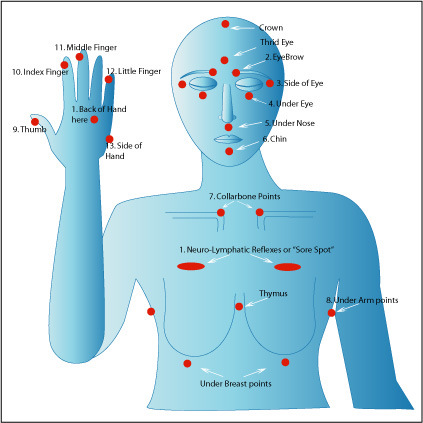
9 EFT Tapping Points
- Side of Hand: The outer edge of your hand, below your pinky.
- Eyebrow point: The inner points of our eyebrows, just above the bridge of your nose
- Side of eye: The bone along the outside point of your eyes
- Under eye: The bon directly under your eyes
- Under nose: Under your nose, right above the center of your lip
- Chin point: The crease below your bottom lip and above your chin
- Collarbone point: The area about once inch below and one inch to the side of where your collarbones meet
- Under arm: The area on your ribcage about four inches below your armpit
- Top of head: The crown of your head
Emotional Freedom Technique (EFT) is an evidence-based self-help therapeutic method and over 100 studies demonstrate its efficacy. Its efficacy for anxiety, depression, phobias and PTSD is well-established. However, information about the physiological effects of EFT is limited. The practice consists of tapping with your fingertips on specific meridian points while talking through traumatic memories and a wide range of emotions. Since its inception in 1995, EFT has been a manualized method, leading to uniform application research, training, and clinical practice. EFT is a brief intervention combining elements of exposure, cognitive therapy, and somatic stimulation of acupressure points on the face and body at their meridians. Put simply, meridian points are certain points that can be mapped throughout the body. Energy circulates through your body along this specific network of channels. You can tap into this energy at any point along the system.
All negative emotions are felt through a disruption of the body’s energy. The body, like everything in the universe, is composed of energy. Restore balance to the body’s energy, and you will mend the negative emotions and physical symptoms that stem from the energy disruption. Tapping restores the body’s energy balance, and negative emotions are conquered.

Hypnotherapy
The terms hypnotherapy and hypnosis are often used interchangeably, but they’re not quite the same thing. Hypnotherapy is a form of psychotherapy that uses hypnosis to treat a health concern. But hypnosis in itself is not a therapy — it’s an everyday waking state we often fall into without even trying.
Hypnotherapy (sometimes called hypnotic suggestion or guided hypnosis) is a therapeutic practice that uses guided hypnosis to help a client reach a trance-like state of relaxation, extreme concentration, focus, diminished peripheral awareness, and heightened suggestibility to achieve a heightened state of consciousness or mindfulness.. Hypnotherapy is an adjunct form of therapy, meaning it is typically used alongside other forms of psychological or medical treatment, such as traditional modes of talk therapy. The idea behind hypnotherapy is that it can be used to reprogram the unconscious or primal parts of the brain that function to avoid pain and seek pleasure. Some people believe that hypnotherapists can control their words and actions while they’re under hypnosis. But the person being hypnotized is always conscious and in control.
Some patients and medical experts worry that hypnotherapy is dangerous. But hypnotherapy is mostly relatively safe and carries fewer risks than other treatments, such as pain medications. Hypnotherapy can also be risky if carried out by someone who’s been poorly trained in hypnotic age regression, a technique in which a patient under hypnosis is instructed to recall a past event or regress to an earlier age to attempt to process a memory. If the hypnotherapist isn’t careful, a patient may develop false memories (called confabulations). And for some patients, those false memories can create emotional trauma.
The American Psychological Association and American Medical Association have recognized hypnotherapy as a valid procedure since 1958, and the National Institutes of Health (NIH) has recommended it as a treatment for chronic pain since 1995.
A person should not use hypnotherapy if they have psychosis or certain types of personality disorder, as it could make their condition worse. Checking with a healthcare provider first is imperative if they have a personality disorder.

Life Coaching
Although life coaching and therapy can complement each other, life coaching is not a substitute for those who need therapy. Through coaching you develop strategic actions and plans to help you move forward in your life. Coaching does not attempt to explain behaviors, delve into your past, diagnose clients, or identify pathology. It is important to understand that coaching is not therapy and does not substitute for therapy if that is what is needed. Coaching does not prevent, cure, or treat any mental disorder or medical diseases. It is important that if you feel psychologically stressed to the point that it is interfering with your ability to function on a daily basis, it is important to seek the help you need in the form of a professional Counselor.
Coaches help people achieve their goals. The basic presumption of coaching is that coaching clients are in a good place mentally and emotionally, and ready to receive guidance and instruction on how to make changes that will help them achieve their goals. The work focuses on creating and maintaining motivation for change, exploring obstacles to change, and creating plans for change. Coaching is more about getting you where you want to be next. Those who benefit best from coaching are those that are committed to put in the effort and do the work necessary to make changes in their life to better themselves or achieve their goals.
The role of a Certified Life Coach is to:
- Provide clients with questions, observation, feedback
- Provide clients with support, encouragement, and accountability to meeting the clients own goals; work with clients to create actionable plans for achievement
- Encourage steps that are action oriented and present or future focused
- Facilitate conversations to help clients find clarity and direction
- The coach may share strategies, insights, tools, or even training based on their own experiences and training
- The coach may offer strategies that benefit the body or the mind and increase wellbeing by helping the client reframe past experiences by improving present and future applications in their daily life.
A Coach asks questions to help you discover and bring out your unique strengths, abilities, and discover a process to harness your vision, provide support and hold you accountable for what you say you will do, and stay with you while you put your ideas into action steps and implement the changes you are choosing for yourself.

Meditation
Meditation is the habitual process of training your mind to focus and redirect your thoughts, and is a type of mind-body medicine. Many styles of meditation can help reduce stress. Meditation can likewise reduce symptoms in people with stress-triggered medical conditions. It is a deliberate focusing of attention to bring about feelings of calm and heightened energy and awareness; it produces a clearing of the mind in ways that promote a sense of calm and heightened awareness. There are many different ways to meditate, such as using a mantra, looking at an object, or focusing on the breath. It can be done sitting still or moving around.
The improved focus you can gain through regular meditation may boost your memory and mental clarity. These benefits can help fight age-related memory loss and dementia. The most common form of meditation is breath meditation, or mindfulness meditation, in which you bring your attention to your breathing. By learning to continually bring your attention to your breath and releasing your thoughts without judgment, you are training your consciousness to remain in the present moment. Making this a habit can lead to an emotionally stable state of mental clarity.
There are two major styles of meditation:
- Focused-attention meditation. This style concentrates attention on a single object, thought, sound, or visualization. It emphasizes ridding your mind of distractions. Meditation may focus on breathing, a mantra, or calming sound.
- Open-monitoring meditation. This style encourages broadened awareness of all aspects of your environment, train of thought, and sense of self. It may include becoming aware of suppressed thoughts, feelings, or impulses.
There are many types of meditation. There are a few specific types that stand out:
- Binaural Beats Meditation – Binaural beats are a form of brainwave entrainment. Using pulses of sound, binaural beats can help the mind get into a state of relaxation, assisting with meditation. Brainwave entrainment is the process of synchronizing multiple beats to become harmonious, and using the resulting soundscape to help the brain enter a relaxed, meditative state. Binaural beats are a common form of brainwave entrainment.
- Chakra Meditation – This type of meditation is based on the idea that blocked or unbalanced chakras can cause negative physical or mental ailments and that by meditating on them we can bring the self back into harmony.
- Focused Meditation – This type of meditation involves concentration using any of the five senses. This is where you focus on something internal, like your breath, or you can bring in external influences to help focus your attention. This practice may be simple in theory, but it can be difficult for beginners to hold their focus for longer than a few minutes at first. If your mind does wander, simply come back to the practice and refocus. This is best for anyone who wants to sharpen their focus and attention.
- Guided Meditation – In guided meditation a teacher leads you through the practice, either in person or via an app or course. This type of meditation is perfect for beginners, as the teacher’s expert guidance can help you get the most out of a new experience.
- Metta Meditation (also known as Loving-kindness Meditation) – Through this technique, you bring your awareness to the people in your life (both near and far, known and unknown, liked or disliked) and direct positive energy and thoughts toward them. This is is used to strengthen feelings of compassion, kindness, and acceptance toward oneself and others. It typically involves opening the mind to receive love from others and then sending well wishes to loved ones, friends, acquaintances, and all living beings. Because this type of meditation is intended to promote compassion and kindness, it may be ideal for those holding onto and looking to decrease feelings of anger or resentment.
- Mantra Meditation – This is prominent in many teachings, including Hindu and Buddhist traditions. This type of meditation uses a repetitive sound to clear the mind. It can be a word, phrase, or sound, one of the most common being “om.” Om Meditation is a form of chanting meditation originating from the Hindu tradition, in which practitioners repeat the word ‘Om.’ The word Om is thought to vibrate at a frequency that connects the mind and body with nature and all things. It’s also thought to increase the vibrations associated with the mantra, helping you enter a more positive and deep state of being. Mantras can be spoken loudly or quietly. After chanting the mantra for some time, you’ll be more alert and in tune with your environment. This allows you to experience deeper levels of awareness. Some people enjoy mantra meditation because they find it easier to focus on a word than on their breath. Others enjoy feeling the vibration of the sound in their body.
- Mindfulness-based Cognitive Therapy Meditation (MBCT), Mindfulness-based Stress Reduction (MBSR), and Mindfulness meditation – MBCT combines both cognitive behavioral therapy and mindfulness. Mindfulness-Based Stress Reduction (MBSR) was developed in 1979 by Jon Kabat-Zinn. It was designed as an 8-week course to help with stress management. MBSR programs have become a standard way to incorporate mindfulness into scientific research. Mindfulness meditation is a secular form of meditation that originates from Buddhist teachings and is the most popular and researched form of meditation in the West. You pay attention to your thoughts as they pass through your mind. You don’t judge the thoughts or become involved with them. You simply observe and take note of any patterns. This practice combines concentration with awareness. This type of meditation trains us to move from thinking to sensing. Rather than dwelling on the past or dreading the future, this meditation encourages you to become aware of your immediate surroundings or experience, crucially without any judgment. It urges us not to get attached to our thoughts but rather just allow them to be. You may find it helpful to focus on an object or your breath while you observe any bodily sensations, thoughts, or feelings. This type of meditation is good for people who don’t have a teacher to guide them, as it can be easily practiced alone.
- Movement Meditation – This is an active form of meditation where the movement guides you into a deeper connection with your body and the present moment. This practice may include walking, qi gong, tai chi, gardening, yoga, or other gentle forms of movement.
- Progressive Relaxation (or body scan meditation) – This is a progressive relaxation practice aimed at reducing tension in the body and promoting relaxation. Oftentimes, this form of meditation involves slowly tightening and relaxing one muscle group at a time throughout the body. In some cases, it may also encourage you to imagine a gentle wave flowing through your body to help release any tension. This form of meditation is often used to relieve stress and unwind before bedtime.
- Spiritual Meditation – focuses on developing a deeper understanding of spiritual/religious meaning and connection with a higher power. It is is the mindful practice of believing in and connecting to something that is greater, vaster, and deeper than the individual self. In this meditation you are trusting that there is something bigger out there and that everything happens for a reason. Spiritual meditation can be practiced at home or in a place of worship. This practice is beneficial for those who seek spiritual growth and a deeper connection to a higher power or spiritual force. Some examples of spiritual meditation are Chan (form of Buddhism), Christian, Kundalini, Kabbalah, Jewish, Islamic, Sufi (branch of Islam), Hindu, Contemplative prayer, Centering prayer, Buddhist, and Shaolin
- Trataka (or candle-gazing mediation) – This is a is a type of meditation in which you keep your eyes open and focused on a point or object—frequently, the flame of a lit candle. Objects such as crystals could also be used. This practice helps bring energy to the third-eye chakra and can increase concentration.
- Transcendental Meditation – This was founded by Maharishi Mahesh Yogi and refers to a specific practice designed to quiet the mind and induce a state of calm and peace. It involves the use of mantra and is best taught by a certified TM practitioner. Transcendental meditation involves sitting with your eyes closed for 20 minutes twice a day repeating a specific and personal mantra (or set of words) given to you by a Transcendental Meditation teacher. The ultimate goal is to transcend or rise above the person’s current state of being.
- Vedic Meditation – Vedic meditation is a form of mantra meditation originating in ancient India. Rather than attempt to observe thoughts without judgment or concentrate on the breath, Vedic meditation simply focuses on the silent repetition of a mantra in order to calm the mind.
- Vipassana Meditation (also called insight meditation) – This technique is thought to have been first taught by the Buddha as a tool to reveal the true nature of existence. Vipassana involves sitting in silence, focusing on the breath and noting any and all physical or mental sensations that arise. The idea is to find “insight” into the true nature of reality (which vipassana teaches is suffering), by examining all aspects of your existence. Some individuals participate in multiday vipassana retreats are a popular way to dive deeper into this practice.
- Visualization Meditation – This is a technique focused on enhancing feelings of relaxation, peace, and calmness by visualizing positive scenes, images, or figures; it involves imagining a scene vividly and using all five senses to add as much detail as possible. It can also involve holding a beloved or honored figure in mind with the intention of embodying their qualities. Another form of visualization meditation involves imagining yourself succeeding at specific goals, which is intended to increase focus and motivation. Many people use visualization meditation to boost their mood, reduce stress levels, and promote inner peace.
- Zazen Meditation – This is a form of Zen meditation emphasizes sitting in stillness, focusing on the present moment, and focusing on the breath. The practice can be found in two schools of Zen, Soto and Rinzai, each with its unique approach to meditation, ultimately leading to a greater sense of peace and clarity. Unlike many meditation techniques, the specific postures used during Zazen meditation are important, and the eyes remain half-open instead of closed during meditation. The hands are often folded in a specific posture as well. Practitioners of this technique aim to gain insight into the empty nature of existence, fostering a deeper understanding of the world and themselves. Zen meditation is working on thinking about nothing (goal is to reach nirvana-like state).
- Zen Koan Meditation – Meditation is a form of Zen. This type of meditation is a way to show up for your own life. It involves focusing on an unanswerable question. For example, “What is the sound of one hand clapping?” Koans are intended to bring the analytical mind to the point of exhaustion, in order to open up space for the intuitive mind.
These include many styles incorporated with them:
- concentrating on the breath – consciously noticing the movement of air in and out of your nostrils, or counting your breaths in various ways
- grounding and mindfulness – being aware of inner experiences (such as bodily sensations, feelings, thoughts and memories) and simply observing them without judgement
- emptying your mind – allowing your mind to clear and ‘float’, gently pushing aside any stray thoughts, or allowing thoughts to float in and out of awareness
- looking at an object – focusing your attention, but not necessarily your thoughts, on the shape, sound and texture of an object such as a tree, a candle flame, or a spiritually significant painting or image
- movement – using a physical technique like yoga, qi gong or tai chi to still your mind by coordinating your breath and body with gentle movement
- using a mantra – repeating a word or phrase over and over, either aloud or silently, sometimes timed with the breath, to focus your attention and brighten your consciousness.
Neurofeedback
This is a non-invasive, medication-free approach for treating brain-based conditions and encourages the brain to develop healthier patterns of activity. Neurofeedback is a type of mind-body therapy under the umbrella of biofeedback. It specifically uses electroencephalograph (EEG) readings, among other methods, to detect brain waves and affect brain activity.
The goal of treatment is not only to change how you think and feel, but also to change your brain on a biological level for better functioning. including ADHD, anxiety disorders, and even autism.
The different types of Neurofeedback represent different brain frequencies and different types of brain functions or reactions. They include:
Frequency and Power Neurofeedback (also called “surface neurofeedback - This is the most simple and common type of therapy. It involves attaching 2-4 electrodes to the head to detect frequencies related to Anxiety, ADHD, and insomnia.
Slow Cortical Potential Neurofeedback (SCP-NF) – This type of therapy aims to help people dealing with ADHD, epilepsy, and migraines. It has even been tested in children1 who have ADHD as a potential alternative to pharmacological solutions.
Low-Energy Neurofeedback System (LENS) – This type of therapy aims to change the patient’s brainwaves while lying motionless with their eyes closed. It’s been used to help people with insomnia, fibromyalgia, restless legs syndrome, anxiety, depression, anger and low energy. This type of therapy doesn’t require any conscious effort from the patient. This type works by attaching the electrodes to the head. This identifies the areas where brain activity is low. The electrodes then emit really low magnetic field frequencies that, over time, can potentially change how the brain functions.
Hemoencephalographic (HEG) Neurofeedback – This type of neurofeedback therapy is for people who have terrible migraines. The electrodes show where the blood flow is in the brain and work to use this information to increase blood flow and reduce the pain or reoccurrence of migraines.
Live-Z Score Neurofeedback – This type of neurofeedback is for people who have insomnia. According to one case study,4 it even improved a group’s symptoms after 15 sessions that were 20-minutes each.
Low-Resolution Electromagnetic Tomography (LORE-TA) – This therapy requires 19 electrode attachments, and that’s because it’s monitoring the brain for particular brain activities pertaining to obsessive-compulsive disorder, addiction, and depression. This type of therapy has revealed5 lots of intricate details about the inner workings of the brains of people with an addiction.
Functional Magnetic Resonance Imaging (fMRI) – This is still a method of neurofeedback therapy that is the most research-based. It uses electrodes to map out the inner workings of the brain.

Neuro-Linguistic Programming (NLP)
NLP was developed NLP was founded by a group of people who made consistent contributions to its discovery. This group includes John Grinder, Richard Bandler, Frank Pucelik, Robert Dilts, Judith Delozier, Leslie Cameron, David Gordon, and others. However, historically John Grinder and Richard Bandler receive the most recognition. NLP asserts that there is a connection between neurological processes, language and acquired behavioral patterns, and that these can be changed to achieve specific goals in life. NLP is based on the idea that people use internal maps to navigate the world. However these maps are often constrained by certain limitations or unconscious biases that are unique to each individual. NLP suggests that our thoughts and experiences are rooted in our neurological processes. It focuses on understanding how individuals perceive the world through their senses. Language and communication greatly influence our thought processes and behavior. NLP examines the language patterns we use, both internally (self-talk) and externally (communication with others). NLP investigates the habitual patterns of thought and behavior that can be changed or “reprogrammed” to achieve specific goals.
NLP employs a variety of techniques for personal development and change:
- Anchoring: Creating associations between certain stimuli and emotional states.
- Incantations (more powerful form of affirmations)
- Milton Model: Using vague language patterns to encourage a person’s unconscious mind to fill in details.
- Mirroring and Matching: Mimicking another person’s behavior to build rapport.
- Modeling/Meta-Modeling: Challenging and clarifying language to uncover deeper meanings.
- NLP Swish: Trains your brain to amplify positives and weaken negatives.
- Reframing: Changing the context or meaning of a situation to alter one’s perception.
- Visualizations: Using mental imagery to achieve desired outcomes.
The NLP Research and Recognition Project, founded by clinical psychologist Frank Bourke, PhD, is a not-for-profit organization created to expand the clinical investigation into Neuro-Linguistic Programming. Dr. Bourke designed and implemented a rehabilitation plan for 800 World Trade Center building survivors after the 9/11 attacks. He discovered that he was able to alter the symptoms of PTSD (trauma) with an NLP-derived protocol more quickly and effectively than with other protocols. As a result of this experience, Bourke founded the NLP Research and Recognition project “to advance the science of Neuro-Linguistic Programming and bring the research up to a scientific standard necessary for more widespread implementation.”

Support Groups
Depending on your needs, you may run into a time when you need or could benefit from a support group. The leader of the group is generally someone who is not struggling with the problem faced by the members of the support group and is specifically trained to provide support to them. This is what sets a support group apart from a self-help group, which is a group that comes together to face challenges without a professional leader. The primary difference between a support group and a self-help group is that a support group is organized and facilitated by a professional or agency, and a self-help group is more peer-led by a group of members.
A support group is a safe place where you can talk about your emotions and circumstances with others who know how you feel, learn coping skills from people who have had similar experiences, can help you grow through those similar experiences, and won’t judge or criticize you. A group of folks in that environment often supply a variety of ways to combat fatigue, feel mentally and physically stronger, and set boundaries for self-care.
mutual support group – Mutual support groups are peer-led groups. Facilitators receive training, but they don’t give advice or act as professionals. Participants in a mutual support group can be people dealing with a certain condition or circumstance, whether it’s a medical issue, domestic abuse, grief, or a mood disorder.
12-step help group, or a therapy group – typically geared toward those with an addiction, such as alcohol, drugs, gambling, or sex. During group meetings, participants work through the 12 steps to recovery created by Alcoholics Anonymous. Like mutual support groups, 12-step self-help groups are peer-led, free, and frequently offer separate groups for the loved ones of those with the addiction.
Therapy groups – mental health providers lead therapy groups. A professional therapist brings several people together who are living with similar conditions and provides treatment to them as a group.
Virtual (also called “Online”) – Online support groups can be a useful and convenient option to in-person meetings. They’re a great alternative if the distance is too far, transportation isn’t available, or your work or family schedule prevents you from attending an in-person support group.
Thank you for visiting the HOPE TBI Website.
Please take the time to make a comment, share your thoughts, and tell us what impacted you the most and what brought you here:
https://hopetbi.com/reviews-and-testimonials
Your input is important to the development and growth of this website, and we like to know what is going on out there in your thoughts.
Thank you for visiting us! We look forward to hearing from you.
 HOPE TBI