Standard of Care

Medical-Standard-Care

What Exactly is “Standard of Care” as it relates to the medical community?

The “medical standard of care” is typically defined as the level and type of care that a reasonably competent and skilled health care professional, with a similar background and in the same medical community, would have provided under the circumstances that led to the alleged malpractice.

A diagnostic and treatment process that a clinician should follow for a certain type of patient, illness, or clinical circumstance.SOC

The level at which the average, prudent provider in a given community would practice. It is how similarly qualified practitioners would have managed the patient’s care under the same or similar circumstances.

1  2

**********************************************************************

I have learned over my entire life through various experiences; also being in the medical field for most of my adult life as a healthcare provider in some way, shape, or form that the Standard of Care is as varied as each personality that goes along with the person representing that Standard of Care.

When I had patients I always tried to give them the best of me and my knowledge of my acquired training at that time.  When I came across something I didn’t know (which was a continual learning process for sure)…. I immersed myself in learning about the things I didn’t know how to answer for what I was specializing in at that time. That was my way of making sure that I didn’t have that same issue come up again.  I guess I just assumed (yes, we know the misnomer of what assume means) that this is how all people sought to learn when they had a passion for medicine.  Specialists in a field even moreso…beyond the norm even.

Specialists, surgeons, Department heads I guess I always expected more of those folks.  Surely they kept up on all the latest trends, the newest studies, the symptomology associated with the topic(s) they specialized in.  Surely they could spot a problem, would assure that the best outcome for the patient was acquired, especially in favor of positive outcomes with their name attached to it.

Surely I could look at them, listen to them use my voice to communicate with them, and trust they knew what they were talking about because after all, their fervor and thirst for knowledge was above and beyond what the average medical professional entailed.  Certainly more than what I was trained to know.do-no-harm

So it only made sense that on that fateful day when I became the voiceless patient, clothing cut off to stark nakedness in an emergency room with massive injuries, multiple broken bones, head injury, and clinging to life with each labored breath…..that the sheer mechanism of injury (severe car wreck with ejection and other driver pinned and needing to be cut out) should have demanded a certain Standard of Care from every provider I came into contact with, within that first year, and every day after that.

I have had some really great providers. I still have some great providers. I want to say that first. There are a handful who have done their due diligence and even exceeded the Standard of Care.  They are the ones that listened.  That actually enjoyed their job and their patients. They are also the ones that keep up on the current and updated things in medicine, ironically enough.  They are the ones who think of ways to make things happen instead of making excuses of why they cannot make things happen.  They are the providers that never give up on you and take risks to better your quality of life.  They are few but mighty.  These are the providers I have learned a lot from and have enormous respect for.

The providers who fell short on their Standard of Care, or didn’t even attempt to live up to it…..  Those providers left me impacted in ways that created a ripple affect that delayed my care, caused me further injuries, and exacerbated things for my recovery process….and not in a positive way.  They are the providers who didn’t listen.  Who jumped to conclusions based on opinion rather than facts.  They fed off of other reports by other providers that also did not care, did not document properly, or dropped the ball in some fantastic and important way;  perhaps even adding wording that invalidated the injuries that actually were quite legitimate and yet ignored.  These are the providers that I felt I knew more about my care and the latest treatments available than they did (yes even if they touted themselves as specialists in that field). These are the providers I lost respect for, or never had the chance to establish such for.

The Standard of Care cannot be overstated in its importance.  If you specialize in a field, learn all you can about that field.  Study it, know it, and be willing to learn more about it. Medicine is changing daily and if a patient brings you the current studies, be grateful. If they discuss them with you and you have never heard about them, go look them up and research them yourself. Knowledge can only make you better at your craft.  If you cannot listen…truly listen to your patient when they say they are still suffering – you are in the wrong line of work.  Go on a quest, do no harm, and advocate for your patients.

The Standard of Care echoes through many professions, yet in this particular post we just address the medical view as a patient, medical advocate, a Survivor.

Expectations+of+Standard+of+Care

Be a HOPEster

A HOPEster is anyone who is interested in helping one person succeed to be independent – even if the person they are currently helping is themselves (specifically related to Polytrauma and Traumatic Brian Injury – though can apply to anything other than these two things as well).  

A HOPEster is someone willing to share information, offer support (whether that be emotional, mental, physical, or just by sharing awareness information), and encourages advocacy (self-advocacy, medical advocacy, advocacy awareness).

A HOPEster is someone that thinks outside the box, is passionate, idealistic, and believes in the inherent goodness of others and our collective responsibility to each other as human beings.


Proud to be a HOPE'ster!

(right click on picture to save to your device or share link in above web browser)

Thank you for visiting the HOPE TBI Website.

Please take the time to make a comment, share your thoughts, and tell us what impacted you the most and what brought you here:

Reviews and Testimonials

Your input is important to the development and growth of this website, and we like to know what is going on out there in your thoughts.

Thank you for visiting us! We look forward to hearing from you.

HOPE TBI – Bring Awareness Campaign

Hello There HOPE’sters.  We are thrilled to announce 2 awareness ads for this website for you to share in emails, in your social encounters both online and offline.

Below each video is a description of what the video is about and why it was created.

Feel free to click the “SHARE” button in the top of which video you like the best, to choose the sharing option you prefer.  SHARE SHARE SHARE….help us bring awareness to others.

This one was created with the thought in mind of how we can overcome anything with the right attitude, with awareness/education, and with proper support.  Support can come in the form of friends, family, providers, and even our own children.  It is important to remember to find our smile, to love, to laugh, and to embrace life and live it to it’s fullest – in spite of our seeming limitations and new realities.  That, in the end, we will be okay – because we have each other – we will overcome!

(of course bubbles always represented to me, a time of innocence, frivolity, and life’s possibilities – you never get too old for bubbles)


This one was created first and the song’s theme is “I will fight for you”.

I created this website with the idea of healing and fighting for myself and my recovery by learning and documenting as much as I could about my injuries…and then documenting what I had learned from my own experiences, documented research, and subjective interpretations.  I created the website with the desire of helping to fight for others with similar injuries (polytrauma or traumatic brain injuries) and help bring Awareness to as many people as possible.  I want it to be a global reach that says:

“Hey, you are not alone out there in your recovery.  You are not alone as a caregiver or a provider – you are not alone with the questions you have, the symptoms you feel, and the life you are struggling to make work for yourself or others”.    

I want this video to be something that is remembered.  Whether you hear the words “I will fight for you” as a song to yourself in your own mind to help you keep going – because your life is truly worth living; or as a representation of your desire to support and advocate for others….that you will fight for them, no matter what; or as a reminder that this site is a place you can come to share, get information, and feel like you are in a place that cares and understands.

The blooming flowers in the video are Cherry Blossom Trees.  This has been symbolic for me for quite some time now.  See our page under CHERRY BLOSSOM TREE PICS.


(any ideas or comments welcome – please post them below or email us through our Contact page)

Memorial Day Observed

Remember that our Veterans often suffer Polytrauma and Traumatic Brain Injuries in the course of battle in defending our Country and are often put into a position of representing our citizens abroad.  They are often put in harms way for the sake of the ideal of standing for the greater good and advocating and doing the proposed right thing.

Let us remember them honorably…those who have gone on before us and given their life in service to others.

The ones that make it home from battle are left to endure the lifelong effects of these life changing events, as are their families with a system that is ill-equipped to handle the atrocities of the perils of war and conflict.  We have come so far over the several generations that extend before our existence.  Our goals should always be to do better than the generation before ours and learn, strive, advocate, and grow – not just as individuals, but as a Nation.

The Veteran’s that don’t make it home, we, as a Country continue to remember.


HISTORY OF MEMORIAL DAY

Memorial Day is an American holiday, observed on the last Monday of May, honoring the men and women who died while serving in the U.S. military.

Originally known as Decoration Day, it originated in the years following the Civil War and became an official federal holiday in 1971.

The date of Memorial Day (also called Decoration Day), was chosen because it wasn’t the anniversary of any particular battle.

For decades, Memorial Day continued to be observed on May 30….. But in 1968 Congress passed the Uniform Monday Holiday Act, which established Memorial Day as the last Monday in May in order to create a three-day weekend for federal employees; the change went into effect in 1971. The same law also declared Memorial Day a federal holiday.

Many Americans observe Memorial Day by visiting cemeteries or memorials, holding family gatherings and participating in parades. Unofficially, it marks the beginning of the summer season..

For more extensive history on this somber holiday…check out http://www.history.com/topics/holidays/memorial-day-history

To all those who serve, or have served….THANK YOU!

Obesity Brain Injury and Trauma

Check out our latest page compiled/completed about Obesity Brain Injury and Trauma

If you have anything you would like to contribute, please let us know.

The Scapula Institute

If you follow this blog and Website you know that I am a survivor of what was a catastrophic motor vehicle accident, which resulted in a polytrauma in 2014. I continue to do my best to address each of my injuries in this website (see the various tabs) and blog about my subsequent rehabilitation (see frequently asked questions page for more information about HOPE TBI).
Through this whole process there are injuries that have been discovered which are somewhat subjective, some that are obviously causal, and then those that are absolutely empirical.  The most empirical injuries in a polytrauma are orthopedic injuries. Yet even with the vast knowledge, sacrifice, and dedication of our best orthopedic professionals, there is still more to learn about the body to facilitate repair and healing.  
At The Scapula Institute (St. Paul, MN) that is exactly what they do. Promote wellness, artistically and methodically delve into the seemingly impossible and make miracles happen.
I know this because I am one of their many success stories thanks to Dr. Peter Cole MD and his Trauma team.  Thanks to The Scapula Institute, Regions Hospital, Health Partners and St. Paul Radiology.  All of them. Working together in a cohesive way to affect change and dish up a bit of HOPE for those who have been cast out as hopeless.  I know this first hand after being told by numerous previous traumatologists that I just had to live with my injuries and they could not be fixed.  They were thankfully VERY wrong about my shoulder and the ability to have it fixed.
Dr. Peter Cole, MD is a visionary and progressive man and an artist with his Scalpel.  It is, in honor of his great works, and in true appreciation of having the majority of the use back in my right shoulder, that I (and HOPE TBI – which is essentially me too – lol) endorse The Scapula Institute and their endeavors.
It is rare to fracture your scapula.  In fact I did not just fracture mine, I shattered it.  That gives you a bit of an indication of the sheer force involved with the wreck and how truly blessed I am to still be here to talk about this.
Information taken from  The Scapula Institute  website: 
 “It is important to know that the majority of scapula fractures do not require surgery. The scapula has a rich blood supply, which helps fractures heal quickly. In addition, the surrounding muscles provide support for the bone during the healing process. These two factors can provide a very favorable environment for healing. There are, however, certain categories that may benefit from surgical intervention.
It is estimated that scapula fractures account for less than 1% of all fractures. It truly is a rare injury with few surgeons experienced in the surgical management of severe fracture variants. Please look through our site and then contact us regarding your specific needs. We are one of the world’s top research teams dedicated to all aspects of shoulder girdle trauma.”
The Scapula Institute has developed optimal diagnostic strategies in addition to pioneering advancements in the surgical treatment of complex fractures. “It is our goal to restore normal function to patients who have sustained injuries to the scapula, clavicle and shoulder girdle unit.”
 The Scapula Institute  has an International referral base. So don’t think that your ability to rehabilitate is limited by your location or Country you come from.

Let me know if you have any questions about my experiences.  I still have a long way to go….however, I am here…alive and able to complete my life journey…now with the use of both of my arms; man does it feel good to be able to hug with both arms again!!!

Never give up HOPE.

Brain Injury does NOT equal Lack of Intelligence

blue brain

Brain Injury does NOT equal Lack of Intelligence

Unless there is objective evidence of brain injury on MRI or CT Scan (hemorrhages, hematoma’s penetrating skull fractures into the brain, etc) people assume the individual expressing symptoms of a traumatic brain injury is faking, exaggerating, or malingering their injuries or the person has psychological problems that had to have pre-existed before their accident.  The reality is that the majority of mild (mTBI) and moderate brain injuries show normal results on an MRI and CT scans.  They do not show diffuse axonal injuries nor do they show levels of intelligence. Keep in mind also, that women also tend to have longer recovery times than men with regard to brain injuries as shown in recent studies.

Diffuse axonal injuries (DAI) are caused by acceleration, deceleration, and contact forces. DAI affects individual nerve fibers which can lead to a disruption in nerve communication.  DAI is microscopic damage to the axons in the brain neural tracts, corpus callosum, and brainstem, is associated with significant mortality and morbidity. When these forces are great enough it creates a shearing force that severs the axons of nerve fibers, which causes nerve cells to die and can create swelling in the brain. The main symptom of diffuse axonal injury is lack of consciousness, which can last up to six hours or more. A person with a mild or moderate diffuse axonal injury who is conscious may also show other signs of brain damage, depending upon which area of the brain is most affected.

Diffuse axonal injury causes cognitive, physical, and behavioral changes that compromise social reintegration, return to productivity, and quality of life of patients and their families. These changes persist beyond the acute phase of treatment and continue for a long period after the traumatic event. Diffuse axonal injury, and more generally TBI, often results in physical, cognitive, and behavioral impairments that can be temporary or permanent.brain network

Due to the diffuse and microscopic nature of the injury, CT scans and general MRIs are typically negative unless small areas of bleeding within the brain are noted within the cerebral cortex or corpus callosum (tracts of white matter in the brain). If a patient presents with unconsciousness and these tests are negative, the medical facility should move onto a different imaging technique to check for DAI. Depending on the severity of the injury and the extent of the damage. A concussion can be considered a mild case of shearing brain injury. At its mildest, DAI can occur unnoticed.

Someone with diffuse axonal injuries that don’t’ show on an MRI or CT scan may also have axonal injurybrain inflammation or swelling.  This can lead to restricted blood supply to the brain tissue and brain herniation. Tonsillar herniation is a type of cerebral herniation characterized by the inferior descent of the cerebellar tonsils below the foramen magnum. Chiari one malformation is a form of tonsillar herniation and is now known to be caused by trauma (like severe whiplash and traumatic brain injury) or in most cases “symptoms awakened” from trauma.  This is an often overlooked correlation between trauma and DAI and TBI.
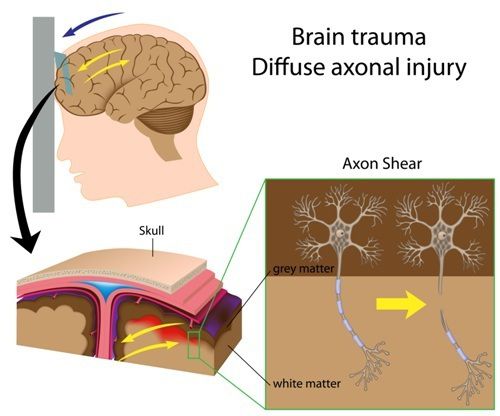
The occurrence of DAI depends on the mechanism of injury; it is more common in higher energy trauma, especially traffic accidents.  Someone who has incurred high velocity trauma, blunt force injuries, or multi-system traumas often have post-traumatic amnesia (PTA).diffuse axonal injury  PTA is another good estimate for severity of a brain injury. Anytime a person has a major blow to the head he or she will not remember the injury and related events for some time afterward. People with these injuries might not recall having spoken to someone just a couple of hours ago and may repeat things they have already said. This is the period of posttraumatic amnesia. The longer the duration of amnesia, the more severe the brain damage.
A brain injury does not necessarily affect intelligence. Intelligence is a stable trait which includes many aspects of cognitive functioning. Following a traumatic brain injury, the brain is unable to function as well as it did prior to injury. This is why we typically see some difficulties with memory or academics. However, once the brain recovers there is no change in a person’s overall intelligence. Your intelligence is based, depending on the definition of intelligence, on the son total of your knowledge.

Someone’s IQ can be unaffected by a TBI, but other parts of the brain that “pilot” or guide one’s brainpower can be messed up. Decision-making and complex social interactions can cause major problems in one’s life and career. The individual with high intelligence may still have cognitive problems such as headache, difficulty thinking, memory problems, attention deficits, mood swings and frustration. These injuries are commonly overlooked, especially in those with high intelligence.  Their low threshold of functioning or slower processing speeds may appear as average where prior to injury they would have tested as above average..

The brain of the intelligent person is more complex in appearance, not as soft, and has greater weight relative to size. Additionally, it can be noted that the intelligent brain may have an enlarged prefrontal cortex or parietal lobe relative to other areas of the brain. More intelligent people have more wires, more connections and more complex architectures in their brains. These are reflective of genetics, as well as developmental experience. blue brain womanAlso, more intelligent people may enjoy higher processing speed or impulse conduction in brain-wires (axons). But with more complexity in the brain, the net result still could look in performances as much slower decision making resulting in a dulled sense of self, lower test scores compared with their education/experiences, and reduced overall performance compared with their performance before injury.
That being said, Intelligence and personality dysfunctions after minor traumatic brain injury (TBI) (whiplash; slight head impact) incurred in a motor vehicle accident (MVA) were studied in adults after an average interval of 20 months. There was a mean loss of 14 points of Full Scale IQ from estimated preinjury baseline IQ determined from the standardization group (WAIS-R) without evidence for recovery. Personality dysfunctions included cerebral personality disorder, psychiatric diagnosis (30 of 33 patients), post-traumatic stress disorder, persistent altered consciousness, and psychodynamic reactions to impairment. Cognitive loss is caused by interaction of brain injury with distractions such as pain and emotional distress. Unreported head impact and altered consciousness at the time of accident contribute to the underestimation of brain trauma after minor TBI.

Just one concussion can lead to a decrease in brain volume, according to a new study in the journal Radiology.

Specifically, researchers from New York University’s Langone School of Medicine found that people who had suffered a mild traumatic brain injury and experienced symptoms of the injury a year later also experienced brain atrophy (brain shrinkage).

“This study confirms what we have long suspected,” study researcher Dr. Yvonne W. Lui, M.D., assistant professor of radiology and the neuroradiology section chief at NYU, said in a statement. After mild traumatic brain injury, “there is true structural injury to the brain, even though we don’t see much on routine clinical imaging. This means that patients who are symptomatic in the long-term after a concussion may have a biologic underpinning of their symptoms.”

brain

Researchers specifically found that those who had sustained a mild-traumatic brain injury had less brain volume in regions linked with anxiety, memory and attention problems.

The bottom line here is that you can have a mild or moderate Traumatic Brain injury with long lasting debilitating symptoms and still have the same intelligence.  You can have a severe traumatic brain injury with empirical radiological evidence and still maintain your intelligence.   Brain injury does not equal lack of intelligence.  A person’s intelligence is not a solid basis for deciding a person’s extent of disability after an injury.

The High IQ TBI  (a blog which is worth the read about high IQ and TBI – this will take you to a different site)

Refrences:

1,  2,  3,  4,  5,  6,  7,  8,  9,  10,  11,  12,  13,  14,  15


New Patient Story Submitted

Hey guys and gals….  Check out our latest story submitted by Tiffany McCullock – Survivor

Mental Illness and TBI

Mental Illness and Brain Injury Are Not a Dual Diagnosis 

https://youtu.be/y3-wLp9RyCs via @YouTube

Survivor Stories

Polytrauma / Trauma / Traumatic Brain Injury

Check out our Survivor Stories

We are working on some submitted stories right now.  If you want to submit yours let us know. See our Story Submission Guide.